






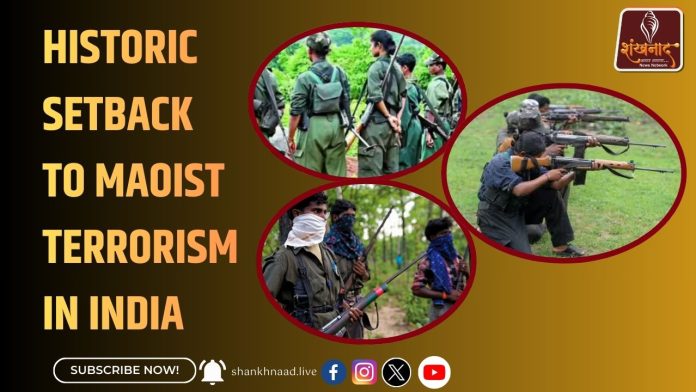

- But will it mutate now? Answer to this question lies in understanding the strategy of ‘Urban Naxals’…
By Senapathi K S …
India’s historic success against Maoist terrorism reached a new milestone with the elimination of Madvi Hidma, the most brutal military commander and Central Committee member of the proscribed CPI (Maoist), on November 18, 2025. This event, coming after the elimination and surrender of other key leaders, signifies a near-collapse of the Maoist armed insurgency, yet opens new questions about the future of extremism—particularly its urban manifestations.
Decimation of Maoist Leadership
The decisive encounter in the forests of Andhra Pradesh led to the death of Hidma and five other Maoist cadres, including his wife Raje. Hidma, widely recognized for masterminding some of the deadliest attacks on security forces—including the 2010 Dantewada massacre where 76 CRPF personnel were killed—represented the last of the core operational leadership. In 2025, security operations also neutralized Nambala Kesava Rao (Basavaraju), the Maoist General Secretary, and facilitated the surrender of top figures such as Mallojula Venugopal Rao and Rupesh (Satish).
Over the past year, security and intelligence agencies, with strong political backing, systematically degraded the Maoist command structure. The CPI (Maoist) Central Committee has shrunk drastically, with many senior members either eliminated, surrendered, or rendered irrelevant due to age and illness. A June 2025 assessment found only four active politburo members and about 300 armed fighters remaining, predominantly concentrated in shrinking strongholds along the Chhattisgarh–Telangana border. For the first time in three decades, a General Secretary-ranked leader was killed, causing further demoralization and disarray within the organization.
The Role of Government Strategy
The turnaround in India’s battle against Maoist extremism was propelled by a multipronged government strategy after 2014, particularly under Prime Minister Narendra Modi and Union Home Minister Amit Shah. Their approach blended uncompromising security pressure with development programs aimed specifically at affected districts. Cooperation across state governments, improved infrastructure, local participation, and advanced surveillance collectively broke the Maoist support network.
As a direct result, the number of Naxal-affected districts dropped from over 120 in 2018 to fewer than 20 by 2025—with only a handful listed as “most-affected”. The violence linked to Maoist activity fell by 84% over the last decade. Security forces regained previously lost territory, and repeated successful operations boosted morale within the ranks.
Impact on Tribal Communities and Political Landscape
Previously, Maoists had significant support from tribal populations. However, sustained violence and use of locals as foot soldiers led to growing disillusionment among tribals. The killing of Hidma, himself from a tribal background, was seen by many as an end to an era of violence that had brought more misery than liberation to these communities.
Political responses have varied. While the government at the center has claimed victory and reinforced its commitment to eradicating all forms of Naxalism by 2026, opposition parties such as Congress have drawn criticism for remaining silent, particularly given Hidma’s role in the 2013 Jeeram Ghati ambush that killed several senior Congress leaders in Chhattisgarh.
The Mutation into Urban Naxalism
With the Maoist presence in forested heartlands nearly wiped out, concerns are shifting to “urban naxals”—a loosely defined network of individuals operating within cities, academic institutions, and civil society groups. Historically, many Maoist leaders were educated and had strong urban connections. Urban Naxals use anonymity and legitimacy granted by roles such as professors, writers, and activists to propagate ideology and recruit youth.
Recent incidents, like the controversial protest in Delhi following Hidma’s death, have drawn attention to urban radicalization, where some student groups attempted to glorify Maoist leaders and link unrelated causes, such as pollution protests, to Maoist narratives. Social media accounts associated with these organizations frequently promote anti-government, anti-corporate, and class-struggle rhetoric, sometimes crossing over into direct support for banned insurgent groups.
They may focus their energies in urban, semi-urban centres. Some even suspect that they may concentrate on revival of trade unionism to plant narratives against economic growth of India, adding fuel to the fire of social faultlines by accelerating radicalisation of particularly the Dalit youths by way of aggressive presentation of caste issues, and also subtly planting divisive agenda by way of amplifying distorted narratives about Constitutional and democratic institutions like the election machinery and investigation agencies and government institutions. Attempts to erode faith of the general public in Constitutional and democratic institutions serves the Maoist agenda of driving people towards becoming mules of anarchy.
Misuse of Cultural Symbolism
A recurring tactic of urban Maoists is to recast historical figures within their revolutionary narrative. In Delhi, student protestors from Bhagat Singh Chhatra Ekta Manch (bsCEM) attempted to equate Madvi Hidma with legendary tribal hero Birsa Munda, distorting cultural symbolism to legitimize violent extremism. Such false equivalence not only insults the legacy of figures like Birsa Munda and Bhagat Singh but also seeks to mask terrorism as social justice.
Preserving Academic Integrity
Security experts and government officials highlight that university campuses and urban spaces could become the next focal points of left-wing extremism now that the armed wing is largely incapacitated. There is an increasing call for vigilance and regulatory action to prevent radicalization, maintain academic integrity, and ensure democratic discourse is not hijacked by anti-national agendas.
The defeat of core Maoist leadership, marked by the death of Madvi Hidma and the collapse of organized armed resistance, represents a historic win for India’s internal security. However, the persistence of urban Naxalite narratives and the risk of their mutation into subtle forms of insurgency necessitate continued vigilance from both government and civil society. Only through a combined strategy of proactive law enforcement, engagement, and development can India ensure that the ghost of Maoism does not resurface in a new urban guise.

Related posts:
मानव-वन्यप्राणी संघर्षावर कायमस्वरूपी उपाययोजना आवश्यक : बंडू धोतरे
May 22, 2026नगर राजभाषा कार्यान्वयन समिति (नराकास-2), नागपुर की छमाही बैठक एवं पुरस्कार वितरण समारोह संपन्न
May 22, 2026छोट्या सवयींचा मोठा फायदा: उन्हाळ्यात वीजबिल आटोक्यात ठेवण्यासोबतच 'अशी' घ्या विजेची काळजी
May 22, 2026